philosophy.trinity.agency
Philosophy
The Geometry of Intelligence
“Synergy means behavior of whole systems unpredicted by the behavior of their parts taken separately.”
- Date
- March 2026
- Version
- v2.0
- Author
- Sergej Götz
Beyond command and control.
Act I — Foundations
Some Things Simply Work.
You know the feeling. A tool that sits perfectly in your hand. A room where you can think clearly the moment you walk in. A team that works without anyone directing it.
And then the opposite: processes that bloat. Companies that grow heavier instead of lighter. Systems that feel like running into a wall.
The difference is never talent. Never budget. Never luck. The difference is always structure.
Structure is what you don't see — but always feel. In the DNA that organizes every cell in your body. In the crystals that refract light. In the team that works without instructions. The same building blocks, everywhere. Only the connection makes the difference.
This document is about structure. Not software. Not technology. But the invisible principle that determines whether something works — or breaks.
Lay regular shapes edge to edge and try to cover a surface — no gaps, no overlaps. Only three succeed: the triangle (6 × 60°), the square (4 × 90°), and the hexagon (3 × 120°). Around every point the interior angles have to close to exactly 360°. A regular pentagon's interior angle is 108°: three leave a gap, four overlap. Every regular polygon above six has the same problem. This is not an observation. It is a proven theorem — and it leaves exactly three omni-equivalent lattices in the plane, embedded in geometry itself.
6 × 60°
4 × 90°
3 × 120°
The Invisible Order
Why should you care — that only three shapes can tile a plane without a gap? Because it shows how fundamentally intelligent this universe structures itself. Not randomly. Not approximately. Exactly. And whoever understands this order can learn from it.
R. Buckminster Fuller — architect, systems thinker, visionary — discovered precisely this principle in the 1940s: connect triangles uniformly in all directions and a network of extraordinary strength emerges — the Isotropic Vector Matrix. No single triangle is strong. The strength comes from the connection — a network in which every element shares the load of the others.
In nature, you see this principle everywhere: in the structure of crystals, in the composition of bones, in the honeycombs of bees. Nature has no meetings. It has no hierarchies. It has geometry.
We believe there is a deeper truth in these patterns. If the universe organizes itself at its most fundamental level through geometry — then information has a structure too. And if information has a structure, then perhaps intelligence does as well. Not as a metaphor. As a principle.
Same Atoms. Different Structure.
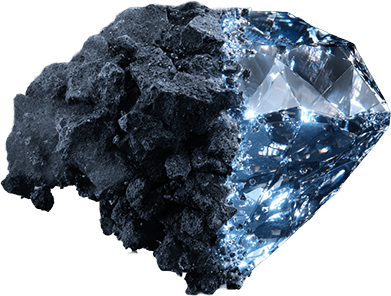
A diamond and a pencil are made of the same element: carbon. The exact same atoms. The difference? How they are connected.
In a diamond, every atom is bonded to four neighbors at the same angle — 109.47° — and those bonds run in all three directions of space. One continuous covalent network, carrying load whichever way you push it.
In graphite, the same atoms are bonded even more tightly — but only inside flat sheets. Between the sheets there is almost nothing: a weak attraction that lets them slide over each other. That is a pencil.
Not weak bonds. The strongest bonds carbon makes, connected in two dimensions instead of three. Isolate a single one of those sheets and you have graphene: the highest tensile strength ever measured — pulled, it outperforms diamond. Same atoms, same bonds. Only the dimension of the connection changed, and one material writes on paper while the other cuts stone.
It is the same in business. Your competitors have the same tools, the same talent pool, the same market. What separates a company that breaks from one that grows harder under pressure is never the material. It is the structure.
This is the insight underlying everything we do at Trinity. Not more resources. Not more effort. Better connections. The same atoms — but a structure that does not yield under pressure, but grows stronger.
Act II — The Bridge
The World Just Changed
Not slowly. Not someday. Now.
Industrial Revolution
Machines multiplied our muscle power.
Digital Revolution
Computers multiplied our computing power.
Agentic Age
Intelligent agents multiply our thinking.
We stand at the threshold of the Agentic Age — the era in which intelligent software agents autonomously understand, plan, and act. Not as a replacement for humans. As a multiplier.
The models exist. The infrastructure is in place. The costs are falling exponentially. The question is no longer whether this future is coming — but who will harness it first.
But intelligence without structure is just noise. What matters is not the technology — but how you connect it. And this is exactly where the difference begins.
Lighter the Larger It Gets
Geodesic spheres — networks of connected triangles — enclose the greatest volume with the least material. From the Biosphère in Montreal to Spaceship Earth at Disney World: wherever architecture pushes against physical limits, this geometry stands as proof that intelligent structure beats any resource.
The part usually called astonishing — that the sphere gets lighter per cubic meter the larger it grows — is not Fuller's discovery. It is the square-cube law: surface grows with r², volume with r³. That holds for any sphere, including one poured from concrete. The arithmetic is free.
What is not free is surviving it. A shell large enough to collect that advantage normally fails under its own weight. Fuller's contribution was the load path: triangulate the surface and every strut carries its force along its own axis, shared across the whole network, with no point left to bend. The geometry does not create the advantage. It is what lets you reach the scale where the advantage exists.
MAX
Output per Input
MIN
Overhead & Friction
INV
Lighter the Larger
Most companies grow heavier the more they scale. More people, more meetings, more overhead, more friction. Geodesic structures show the other path: properly connected, every new element becomes not a burden, but a reinforcement.
Intelligent Systems = Intelligent Structure
A system is nothing more than structure in motion. How parts are connected determines what the whole can do — not how many parts it has. That is why poorly structured systems become more fragile with every growth spurt, while well-structured ones grow stronger with every element. Structure is not a feature of a system. Structure is the system.
Trinity builds systems that follow these universal structural principles. Our approach — Context Engineering — makes visible what most companies never question: the hidden architecture of their processes, decisions, and data flows. Where context is missing or wrongly connected, the structural weaknesses on which entire business models are built emerge.
Who Understands Systems, Wins
Every epoch had its science. Physics explained motion. Chemistry explained transformation. Biology explained life. Mathematics gave them a language.
Computer Science is different. It does not examine one aspect of the world — but the structure of information itself. How does knowledge arise? How are decisions made? How does order emerge from chaos?
Whoever understands the structure can ask any question. That is the unfair advantage of our time — and it belongs to those who can read systems, not to those who shout the loudest.
Marvin Minsky
Founding father of Artificial Intelligence at MIT
Intelligence is a society of simple processes that together produce something greater than the sum of its parts.
Fuller's Isotropic Vector Matrix. Minsky's Society of Mind. Tesla's 3-6-9.
Three thinkers, three epochs, one insight:
Intelligence emerges not through control, but through connection.
Act III — The Arrival
The Higher Functions of Life
“One day there will be intelligent machines that take over our thinking — so that we have more time for the higher functions of life.”
The higher functions of life. Not efficiency. Not optimization. But what you actually set out to do.
Imagine a morning when you wake up and know: your systems are working. Not roughly. Not mostly. They work. Orders flow. Processes mesh. Communication is clear. And you — you have time.
Time, not for another meeting. Not for another fire drill. But for the things that truly matter: the idea you have been putting off for months. The conversation with the client that deepens the relationship instead of merely extending the contract. The afternoon with your family, without the feeling that something is on fire.
Creativity. Relationship. Beauty. Meaning. These are not luxuries for someday. They are the goal. Everything else — the systems, the agents, the structure — is the means.
The question is not whether you can afford it. The question is whether you can afford not to.
What If?
No more theory. No more references. Just you and an honest question.
What would your business look like if every system worked exactly as it should?
If you got ten hours back every week — not for more work — what would you really do with them?
And now the other side:
How much time have you already lost to systems that don't work? Not money — time. The meetings that should have been decisions. The months spent rebuilding something that should have been built right from the start.
How many good ideas have stayed in the drawer — not because they were bad, but because there was no capacity?
Structure doesn't give answers. But it creates the space where the right questions finally have room.
3 · 6 · 9
3
The Triangle
Fix three lengths and the shape is fixed. A triangle cannot flex without breaking a side — every other polygon can. The only rigid unit.
6
The Hexagon
The way a plane fills itself with the least edge. Graphene — one hexagonal sheet of carbon — holds the highest tensile strength ever measured.
9
The Completion
9 × n, digit sum always 9 — in base 10, and only there. A property of our notation, not of nature. We use it as a name, not as an argument.
Three and six are theorems. Nine is a name. The digit-sum property holds in base ten and nowhere else — in base twelve the same trick belongs to eleven — and the Tesla line it is usually hung on has never been traced to anything he wrote. We kept the number because it is ours. The two that carry weight carry it on their own.
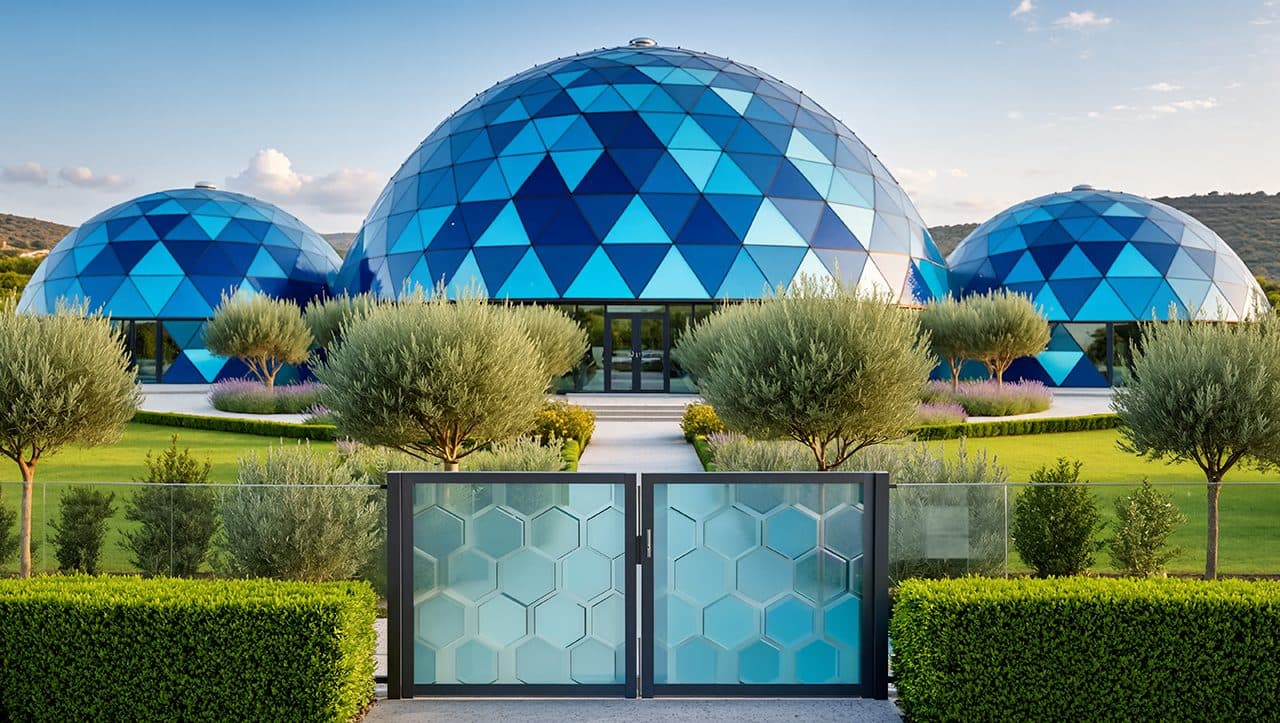
Our vision: in 2027, the Trinity Innovation Lab will be established near Paphos, Cyprus — a research center built on the principles of geodesic geometry. At its core lies the study of carbon and context — how structure at the atomic and informational level generates intelligence. Through a metaphysical lens that connects materials science, geometry, and emergent systems.
An Invitation
This document is not a pitch. It is a way of thinking.
If you have read this far, it is not because we sell well — but because you recognized something you have felt for a long time: that the way most companies are built is not the best way. That there is a more elegant structure.
Trinity Agency exists for people who think this way. For founders, entrepreneurs, visionaries — people who want to build something greater than themselves.
Contact
SG Trinity Agency Ltd.
Sergej Götz
info@trinity.agency
www.trinity.agency
Onisiforou Center, Corner of Neof. Nikolaides Ave & Theod. Kolokotronis Str, 2nd Floor
8011 Paphos, Cyprus
Trinity Lab
Non-profit Association, Austria
Research: Geometric Intelligence, Crystallography, Emergent Systems